Current File : //scripts/comet_pkgacct_stream_guard
#!/usr/local/cpanel/3rdparty/bin/perl

#                                      Copyright 2026 WebPros International, LLC
#                                                           All rights reserved.
# copyright@cpanel.net                                         http://cpanel.net
# This code is subject to the cPanel license. Unauthorized copying is prohibited.

package scripts::comet_pkgacct_stream_guard;

use cPstrict;

=encoding utf-8

=head1 NAME

comet_pkgacct_stream_guard - fail a Comet backup rather than vault a corrupted
C<pkgacct --stdout-archive> stream (CPANEL-55666)

=head1 SYNOPSIS

comet_pkgacct_stream_guard <cpanel_user> [ pkgacct option ... ]

=head1 DESCRIPTION

The legacy C<databases_program_output> and C<pkgacct_program_output> Protected
Items are C<engine1/stdout> sources: the Comet C<backup-tool> agent forks the
item's C<EngineProps.COMMAND> and streams the command's STDOUT straight into the
Storage Vault. Under C<--stdout-archive>, B<STDOUT IS THE ARCHIVE>.

That makes any core code path which prints to STDOUT during a C<pkgacct> run a
silent data-loss hazard, and there is one:
C<Cpanel::Pkgacct::Components::Mysql> hardcodes C<< ERRORS_TO_STDOUT => 1 >>
(Mysql.pm:673) and C<Cpanel::DBAdmin> raw-prints its error text to STDOUT
(DBAdmin.pm:201). A single stale C<dbmap> entry therefore PREPENDS a few hundred
bytes of human-readable error text to the gzip stream. C<pkgacct> still exits
B<0> with an empty STDERR, so the agent records a perfectly successful backup of
an archive that C<gzip> cannot open and C<restorepkg> cannot extract. The core
half of that is a separate case; this guard is the plugin's half.

C<run()> forks C<pkgacct> with its STDOUT on a pipe and inspects the FIRST TWO
BYTES (after any leading blank bytes) before anything reaches our own STDOUT:

=over 4

=item * B<leading blank bytes> — up to C<$MAX_LEADING_WHITESPACE_BYTES> of
C<\n>, C<\r>, space and tab ahead of the gzip magic are skipped and NOT written
(CPANEL-57691: core C<pkgacct> prints blank lines before the archive for accounts
with Mailman lists). How many were skipped is logged to
C</var/log/comet_backup.log>, NOT to STDERR: the agent grades any STDERR output as
a warning (Comet 7001), which fails the backup. The checks below apply to the
first two bytes after them.

=item * B<gzip magic (C<\x1f\x8b>)> — the two bytes are written through and the
rest of the stream is pumped verbatim to STDOUT until EOF. On the happy path
this is a pure passthrough, so the vaulted CONTENT is byte-identical to what the
un-wrapped C<pkgacct> COMMAND produced. C<pkgacct>'s own exit status is then
propagated.

=item * B<anything else> — this is the corruption case, and the leading bytes
ARE the error message the administrator needs. Up to
C<$MAX_CAPTURED_GARBAGE_BYTES> of them are captured and printed to STDERR (which
the agent files into the Comet job log), the rest of the stream is DRAINED AND
DISCARDED, and the guard exits non-zero having written B<ZERO BYTES> to STDOUT.

=item * B<EOF before two bytes> — an empty stream. Nothing is written, a
diagnostic naming CPANEL-55666 goes to STDERR, and the guard exits non-zero.

=back

B<Zero bytes on STDOUT is load-bearing, not tidiness.> Comet grades a
C<engine1/stdout> job that exits non-zero having produced SOME output as a
FAILED_WARNING rather than a hard failure, and this plugin's own
C<_warning_completion_is_success> treats several warning shapes as success. A
non-zero exit with no output is what makes the job unambiguously failed, so a
corrupted snapshot is never recorded as a restore point.

B<There is deliberately NO full-stream gunzip validation, and that is a design
decision rather than an omission.> C<pkgacct> dumps every database into its
working directory B<before> it streams the tar, so the whole demonstrated error
class — C<DBAdmin> printing to STDOUT from the C<Mysql> component — lands
B<ahead> of the archive bytes. A two-byte head check therefore covers it at zero
streaming cost, whereas decompressing every byte of a multi-gigabyte account
archive in-line would double the CPU of every legacy backup to catch a class of
corruption nobody has observed.

The C<pkgacct> path lives in the package variable C<$PKGACCT_BIN> purely so the
unit suite can point it at a fixture after C<do>-loading this file. It is
B<deliberately not> settable from the environment or the command line: this
program is exec'd by the backup agent from a string stored on the Comet server,
so an override would be runtime attack surface for no operational gain.

=cut

# Path to the real pkgacct. A package variable ONLY so t/small can retarget it
# after do-loading this file; never read from %ENV or @ARGV (see the DESCRIPTION).
our $PKGACCT_BIN = '/usr/local/cpanel/scripts/pkgacct';

# gzip's two-byte file magic. pkgacct --stdout-archive always emits a gzip
# stream (it is a .tar.gz), so these are the first two bytes of every good run.
our $GZIP_MAGIC = "\x1f\x8b";

# How much of a corrupted stream's leading garbage is echoed to STDERR. The
# DBAdmin error text this exists to surface is a few hundred bytes; the cap
# keeps a pathological stream from flooding the Comet job log.
our $MAX_CAPTURED_GARBAGE_BYTES = 4096;

our $READ_CHUNK_BYTES = 65_536;

# CPANEL-57691: core pkgacct can print a few blank lines to STDOUT before the
# archive (seen with Mailman lists on 138: "\n\n\n" then the gzip data). Up to
# this many leading whitespace bytes (\n, \r, space, tab) are skipped before the
# gzip magic is required. The cap keeps a stream of nothing but whitespace from
# being read forever.
our $MAX_LEADING_WHITESPACE_BYTES = 4096;

exit run(@ARGV) unless caller;

=head1 FUNCTIONS

=head2 run( @argv )

Runs C<$PKGACCT_BIN @argv> behind the head check described above. Returns the
process exit code: 0 only when the stream carried gzip magic, was pumped through
in full, and C<pkgacct> itself exited 0.

=cut

sub run (@argv) {

    # A vanished consumer must not kill us mid-write: with SIGPIPE ignored the
    # syswrite below fails EPIPE instead, so the child is still reaped and an
    # exit code is still chosen deliberately.
    local $SIG{'PIPE'} = 'IGNORE';

    binmode STDOUT;

    my $out_fh = _spawn_pkgacct(@argv) or return 1;

    my ( $skipped, $head ) = _read_head($out_fh);

    return _refuse_truncated_stream( $out_fh, $head )         if !defined $head || length($head) < length $GZIP_MAGIC;
    return _refuse_corrupt_stream( $out_fh, $head, $skipped ) if $head ne $GZIP_MAGIC;

    _note( 'Skipped blank bytes that pkgacct printed before the account backup archive', { user => $argv[0] // '', bytes => $skipped } ) if $skipped;

    return _pass_stream_through( $out_fh, $head );
}

=head2 _read_head( $fh )

Reads the stream's head: skips up to C<$MAX_LEADING_WHITESPACE_BYTES> leading
whitespace bytes (C<\n>, C<\r>, space, tab), then reads the next two bytes.
Returns C<( $skipped_count, $head )>. C<$head> is C<undef> on a read error and
shorter than two bytes at EOF. Once the cap is reached a further whitespace byte
is NOT skipped, so it becomes part of C<$head> and the stream is refused.

The skipped bytes are dropped; everything from the gzip magic on is passed
through unchanged, so the stored archive is exactly the gzip data.

=cut

sub _read_head ($fh) {
    my $skipped = 0;
    my $byte;

    while (1) {
        $byte = _read_exactly( $fh, 1 );
        return ( $skipped, $byte ) if !defined $byte                     || !length $byte;
        last                       if $byte !~ m{\A[\x09\x0a\x0d\x20]\z} || $skipped >= $MAX_LEADING_WHITESPACE_BYTES;
        $skipped++;
    }

    my $rest = _read_exactly( $fh, length($GZIP_MAGIC) - 1 );
    return ( $skipped, defined $rest ? $byte . $rest : undef );
}

# Forks $PKGACCT_BIN with its STDOUT on a pipe we own. STDERR is inherited on
# purpose: pkgacct's own diagnostics belong in the Comet job log unchanged.
sub _spawn_pkgacct (@argv) {
    my $fh;
    my $pid = open( $fh, '-|', $PKGACCT_BIN, @argv );

    if ( !$pid ) {
        my $err = $!;
        _diag("could not run $PKGACCT_BIN: $err");
        _diag('No backup data was produced.');
        return;
    }

    binmode $fh;
    return $fh;
}

# EOF (or a read error) before even the two magic bytes could be read. Reported
# separately from the wrong-magic case because the operator's next step differs:
# there is no leading garbage to read here, only an archive that was not produced.
sub _refuse_truncated_stream ( $out_fh, $head ) {
    my $got    = defined $head ? length $head : 0;
    my $status = _reap($out_fh);

    _diag("the account backup produced no data (it ended after $got byte(s)).");
    _diag( sprintf( 'pkgacct exited with status %d. The backup failed and nothing was stored.', _exit_code_from_status($status) ) );

    return 1;
}

# Wrong magic: the leading bytes are error TEXT that core printed into the
# archive stream. Surface them, discard the stream, write nothing.
sub _refuse_corrupt_stream ( $out_fh, $head, $skipped = 0 ) {
    my $captured = $head . _drain( $out_fh, $MAX_CAPTURED_GARBAGE_BYTES - length $head );
    my $status   = _reap($out_fh);

    my $hex = join( ' ', map { sprintf( '0x%02x', ord ) } split( //, $head ) );

    _diag('the account backup data is not a valid archive and was discarded. The backup failed.');
    _diag( $skipped ? "After $skipped blank byte(s), the next two bytes were $hex, expected 0x1f 0x8b." : "First two bytes were $hex, expected 0x1f 0x8b." );
    _diag( sprintf( 'pkgacct exited with status %d.', _exit_code_from_status($status) ) );
    _diag('The error text pkgacct printed is shown below:');
    _diag_block($captured);

    return 1;
}

# Happy path: write the magic we consumed, then pump the rest verbatim.
sub _pass_stream_through ( $out_fh, $head ) {
    my $pump   = _write_all($head) ? _pump($out_fh) : 'write_error';
    my $status = _reap($out_fh);

    if ( $pump eq 'write_error' ) {

        # The vault side went away. Quiet on purpose: this is not a corrupted
        # snapshot, it is a consumer that stopped reading, and the agent already
        # knows why.
        _diag('the backup destination stopped reading before the backup finished; aborting.');
        return 1;
    }

    if ( $pump eq 'read_error' ) {
        _diag('could not read all of the account backup data. The backup failed.');
        return 1;
    }

    my $exit_code = _exit_code_from_status($status);
    if ($exit_code) {
        _diag("pkgacct exited with status $exit_code. The backup failed.");
        return $exit_code;
    }

    return 0;
}

=head2 _read_exactly( $fh, $want )

Reads exactly C<$want> bytes, looping over short C<sysread>s. Returns the bytes
read (possibly fewer than C<$want> at EOF), or C<undef> on a read error.

=cut

sub _read_exactly ( $fh, $want ) {
    my $buf = '';

    while ( length($buf) < $want ) {
        my $got = sysread( $fh, my $chunk, $want - length($buf) );
        return undef if !defined $got;
        last         if $got == 0;
        $buf .= $chunk;
    }

    return $buf;
}

# Reads the rest of the stream to EOF, keeping at most $limit bytes of it. The
# child is NEVER killed: it is left to finish writing into a pipe we are
# draining, which is what keeps this a clean reap instead of a SIGPIPE race.
sub _drain ( $fh, $limit ) {
    my $captured = '';

    while (1) {
        my $got = sysread( $fh, my $chunk, $READ_CHUNK_BYTES );
        last if !defined $got || $got == 0;

        my $room = $limit - length $captured;
        $captured .= substr( $chunk, 0, $room ) if $room > 0;
    }

    return $captured;
}

# Copies $fh to STDOUT until EOF. Returns 'ok', 'read_error' or 'write_error'.
sub _pump ($fh) {
    while (1) {
        my $got = sysread( $fh, my $chunk, $READ_CHUNK_BYTES );
        return 'read_error'  if !defined $got;
        last                 if $got == 0;
        return 'write_error' if !_write_all($chunk);
    }

    return 'ok';
}

# syswrite can be short; loop until the whole buffer is out. Returns 0 on any
# write failure, EPIPE included (SIGPIPE is ignored by run()).
sub _write_all ($data) {
    my $len     = length $data;
    my $written = 0;

    while ( $written < $len ) {
        my $wrote = syswrite( STDOUT, $data, $len - $written, $written );
        return 0 if !defined $wrote;
        $written += $wrote;
    }

    return 1;
}

# Closing a piped filehandle waits for the child and puts its wait status in $?.
sub _reap ($fh) {
    close $fh;
    return $?;
}

sub _exit_code_from_status ($status) {
    return 0 if !$status;

    my $code = $status >> 8;
    return $code if $code > 0 && $code < 256;

    # Death by signal, or a status we cannot express as an exit code.
    return 1;
}

# CPANEL-57691: a note for /var/log/comet_backup.log, never STDERR. The agent grades an
# engine1 job that wrote anything to STDERR as a warning (Comet status 7001), and the
# plugin fails a warning, so a line on STDERR would fail the very backup it describes.
# Fail-soft and silent: a log that cannot be written must not change the result.
sub _note ( $message, $context = {} ) {
    local $@;
    local $SIG{'__WARN__'} = sub { };
    eval {
        require Whostmgr::CometBackup::Logger;
        Whostmgr::CometBackup::Logger->new()->info( $message, $context );
        1;
    };
    return;
}

sub _diag ($message) {
    print {*STDERR} "comet_pkgacct_stream_guard: $message\n";
    return;
}

# Echoes captured stream bytes, rendering anything that is not printable ASCII
# (or tab/newline) as an escape so a binary fragment cannot mangle the job log.
sub _diag_block ($bytes) {
    my $rendered = $bytes;
    $rendered =~ s{([^\x09\x0a\x20-\x7e])}{sprintf( '\\x%02x', ord $1 )}ge;

    print {*STDERR} "--- begin captured stream head ---\n$rendered\n--- end captured stream head ---\n";
    return;
}

1;
A peticion de nuestros usuarios, hemos decidido crear estas barras en las que puedes crear facilmente los iconos de tus redes sociales orientadas en la PARTE SUPERIOR de los perfiles,…
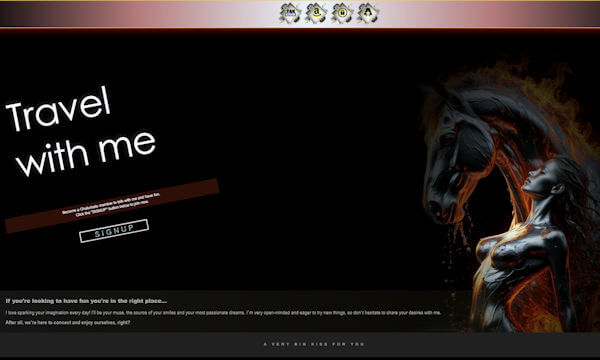
Diseño perfil Chaturbate - Es muy importante crear tu perfil de modelo en Chaturbate. Muchos de los usuarios buscan un poco mas de información acerca de ti y todavía mas,…
Eleva tu imagen como modelo con un espacio diseñado para provocar, atraer y convertir miradas en deseo. Un perfil impactante no solo transmite estilo y seguridad, sino que anticipa la…
Sutileza, estilo y presencia. Eleva tu imagen como modelo con un perfil limpio, cuidado y sofisticado. Un diseño armonioso transmite seguridad, profesionalismo y una experiencia más exclusiva para tus seguidores.…
Porque tu contenido merece un buen marco: este diseño realza tu perfil, mejora la navegación y deja claro que eres una modelo que se toma su trabajo en serio. Ver…
Eleva tu imagen como modelo: un perfil bien diseñado transmite seriedad, estilo y una experiencia más cuidada para tus seguidores. Ver Demo Las instrucciones con imagenes estan disponibles en este…
Pensado para atraer, retener y fidelizar: un diseño funcional y sexy que acompaña tu show y refuerza tu presencia en Chaturbate. Ver Demo Las instrucciones con imagenes estan disponibles en…
Haz que tu perfil hable por ti: este diseño destaca tu personalidad y crea una conexión inmediata con quienes entran a conocerte. Ver Demo Las instrucciones con imagenes estan disponibles…
Un perfil que vende sin decirlo: estilo sensual y orden visual que comunica valor, exclusividad y profesionalismo. Ver Demo Las instrucciones con imagenes estan disponibles en este articulo. El codido…
Diseño estratégico para modelos ambiciosas: mejora la primera impresión, organiza tu contenido y potencia la interacción con tus viewers. Ver Demo Las instrucciones con imagenes estan disponibles en este articulo.…
Impacto visual que atrae más miradas: una estética pensada para llamar la atención y hacer que tu perfil no pase desapercibido. Ver Demo Las instrucciones con imagenes estan disponibles en…
Tu espacio, tu identidad: este diseño te ayuda a mostrar quién eres, qué ofreces y por qué vale la pena quedarse en tu sala. Ver Demo Las instrucciones con imagenes…
 Mini Shell